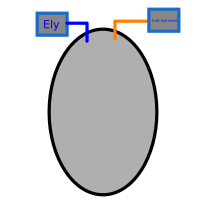
modelElectrolyzerAndCavern

Information
1. Purpose of model
This simple model simulates the behavior of a hydrogen cavern. It should be used together with the component TransiEnt.Producer.Combined.LargeScaleCHP.H2CofiringCHP.
The default parameters are based on the sample cavern of one of the NOW studies [1].
2. Level of detail, physical effects considered, and physical insight
Loading:
- This component takes into consideration the amount of power being sent to the electrolyzer to calculate the produced amount of hydrogen.
- The cavern ist loaded as long as there is enough unused capacitiy in the cavern.
- The efficiency of the electrolyzer is constant and in regard to the lower heating value (NCV).
Unloading:
- Hydrogen is unloaded from the cavern if there is enough hydrogen in the cavern (more than the cushion-gas) and if there is hydrogen demand.
- The amount of hydrogen to be unloaded depends on the co-firing ration as defined in SimCenter.k_H2_fraction.
3. Limits of validity
Due to its simplifcation level, this model should not be used for detailed dimensioning of underground hydrogen caverns.
Its usage is rather recommended for large system models.
4. Interfaces
Inputs:
- P_ely_set
- Q_flow_fuel_GuD
Outputs:
- h2Available (boolean)
5. Nomenclature
Electrolyzer Parameters:
- P_nom_ely: nominal electric power of electrolyzer
- eta_nom_ely: nominal efficiency of electrolyzer
Cavern Parameters:
- medium: gas stored in the cavern (used for calculating the density)
- V_cavern: cavern geometric volume (converted into mass via calculated density)
- V_cushion: cushion gas volume (converted into mass via calculated density)
- k_H2_fraction: co-firing ratio (Q_flow_fuel_H2/Q_flow_fuel_CH4)
6. Governing Equations
(no equations)
7. Remarks for Usage
(none)
8. Validation
See Check-Model "TransiEnt.Producer.Gas.Electrolyzer.Systems.Check.TestElectrolyzerAndCavern"
9. References
[1] Stolzenburg, Klaus ; Hamelmann, Roland ; Wietschel, Martin ; Genoese, Fabio ; Michaelis, Julia ; Lehmann, Jochen ; Miege, Andreas ; Krause, Stephan ; Sponholz, Christian ; u. a.: Integration von Wind-Wasserstoff-Systemen in das Energiesystem Abschlussbericht, 2014
10. Version History
Ricardo Peniche, 2016
Sources:
Parameters
| Type | Name | Default | Description |
|---|---|---|---|
| Modelica.Units.SI.MassFlowRate | m_flow_max_in | 10.5*(1000/3600) | Maximum mass flow into the cavern |
| Modelica.Units.SI.MassFlowRate | m_flow_max_out | 13.5*(1000/3600) | Maximum mass flow into the cavern |
| Real | k_H2_fraction | simCenter.k_H2_fraction | |
| Boolean | integrateMassFlowOut | false | true if mass flow output shall be integrated |
| Boolean | integrateMassFlowIn | false | true if mass flow input shall be integrated |
| Cavern › Gas Properties | |||
| TILMedia.VLEFluidTypes.BaseVLEFluid | medium | TransiEnt.Basics.Media.Gases.VLE_VDIWA_H2() | Medium to be used |
| ClaRa.Basics.Units.MassFraction[medium.nc - 1] | X_const | zeros(medium.nc - 1) | Constant composition: 100% hydrogen |
| Modelica.Units.SI.Pressure | p_cavern_nom | 100e5 | Cavern nominal pressure |
| Modelica.Units.SI.Temperature | T_cavern | 20 + 273.15 | cavern temperature |
| Cavern › Size and capacity | |||
| Modelica.Units.SI.Volume | V_cavern | 500e3 | Cavern volume |
| Modelica.Units.SI.Volume | V_cushion | (1 - 0.63)*V_cavern | |
| Modelica.Units.SI.Volume | V_initial | V_cushion | |
| Electrolyzer › Size and capacity | |||
| Modelica.Units.SI.Power | P_nom_ely | 400e6 | Nominal power capacity of the electrolyzer |
| Real | eta_ely_nom | 0.7 | |
| Hydrogen pipeline | |||
| Modelica.Units.SI.Length | L | 12e3 | |
Connectors
| Type | Name | Default | Description |
|---|---|---|---|
| Modelica.Blocks.Interfaces.BooleanOutput | h2Available | ||
| TransiEnt.Basics.Interfaces.Electrical.ElectricPowerIn | P_set_ely | Input for electric power | |
| TransiEnt.Basics.Interfaces.Thermal.HeatFlowRateIn | Q_flow_fuel_GuD | Heat flow rate of the fuel |
Components
| Type | Name | Default | Description |
|---|---|---|---|
| TransiEnt.SimCenter | simCenter | ||
| TransiEnt.ModelStatistics | modelStatistics | ||
| Modelica.Units.SI.Mass | m_cushion | cushion / base gas | |
| Modelica.Units.SI.Density | rho | density of stored gas | |
| Modelica.Units.SI.SpecificEnergy | LHV | 120e6 | |
| Modelica.Units.SI.HeatFlowRate | Q_flow_GuD_H2 | ||
| Modelica.Units.SI.Power | P_in_ely | ||
| Modelica.Units.SI.Energy | E_storage | ||
| Modelica.Units.SI.Energy | E_initial | ||
| Modelica.Units.SI.Energy | E_storage_max | ||
| Modelica.Units.SI.Mass | m_initial | Initial mass in cavern | |
| Modelica.Units.SI.Mass | dm_storage | Mass in cavern | |
| Modelica.Units.SI.Mass | m_storage | Mass in cavern | |
| Modelica.Units.SI.Mass | m_out | Mass in cavern | |
| Modelica.Units.SI.Mass | m_in | Mass in cavern | |
| Modelica.Units.SI.Mass | m_max_cavern | Cavern maximum mass capacity | |
| Modelica.Units.SI.MassFlowRate | m_flow_in | Mass flow into cavern | |
| Modelica.Units.SI.MassFlowRate | m_flow_out | Mass flow out of cavern | |
| Modelica.Units.SI.MassFlowRate | m_flow_nom_ely | Nominal mass flow electrolyzer | |
| Modelica.Units.SI.MassFlowRate | m_flow_ely | Mass flow electrolyzer (limited) | |
| Modelica.Units.SI.VolumeFlowRate | V_flow_ely | Volume flow electrolizer | |
| Modelica.Units.SI.VolumeFlowRate | V_flow_nom_ely | Volume flow electrolizer | |
| Real | Level | ||
| TILMedia.Internals.VLEFluidConfigurations.FullyMixtureCompatible.VLEFluid_pT | vleFluidH2 | Model of used medium (hydrogen) | |
| Components.Statistics.Collectors.LocalCollectors.CollectCostsGeneral | collectCosts_PtG_Ely |