modelThermalResistorVertical_withDispersion
Extends from Modelica.Thermal.HeatTransfer.Interfaces.Element1D (Partial heat transfer element with two HeatPort connectors that does not store energy).
Information
1. Purpose of model
Quasi-static vertical thermal resistor for heat conduction between two vertically neighbouring aquifer control volumes. Optionally adds hydrodynamic dispersion to the effective thermal conductivity based on the local vertical Darcy velocity.
2. Level of detail, physical effects considered, and physical insight
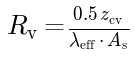
L1: Quasi-static 1D heat transport in vertical direction. No thermal storage within the resistor. Thermal resistance is computed from half the control volume height and the cross-sectional area. Dispersion increases effective conductivity proportionally to the magnitude of the vertical Darcy flux.
3. Limits of validity
- No thermal mass inside the resistor (instantaneous conduction).
- The factor 0.5 in the resistance formula assumes the temperature node sits at the centre of the control volume.
4. Interfaces
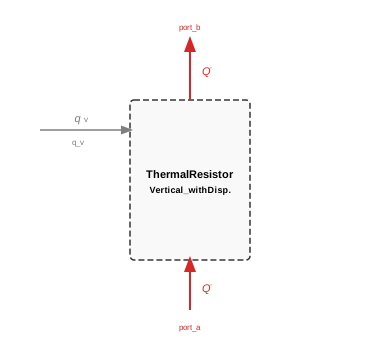
port_a: lower heat port — heat inlet (Heat, inherited from Element1D)
port_b: upper heat port — heat outlet (Heat, inherited from Element1D)
q_v: vertical Darcy velocity input for dispersion calculation (Signal)
5. Nomenclature
|
R |
vertical thermal resistance [K/W] |
|
lambda_overall |
effective thermal conductivity incl. dispersion [W/(m·K)] |
|
lambda_disp |
dispersion contribution to thermal conductivity [W/(m·K)] |
|
q_v |
vertical Darcy velocity [m/s] |
|
z |
height of control volume [m] |
|
A |
cross-sectional area of control volume [m²] |
|
disp_length |
vertical dispersivity length [m] |
|
C_f |
volumetric heat capacity of fluid [J/(m³·K)] |
|
Q_flow |
heat flow rate [W] (inherited from Element1D) |
|
dT |
temperature difference across resistor [K] (inherited from Element1D) |


6. Governing Equations
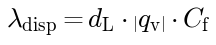
Effective thermal conductivity with optional dispersion:
Vertical thermal resistance (half-cell formulation):
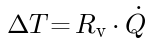
Heat transport (inherited from Element1D):
7. Remarks for Usage
Connect q_v to the q_trans output of the corresponding ControlVolumeL4 cell. Set dispersion = false (default) to use pure conduction.
8. Validation
(no remarks)
9. References
(no remarks)
10. Version History
Model created by Markus Gillner (markus.gillner@tuhh.de), May 2026
Parameters
| Type | Name | Default | Description |
|---|---|---|---|
| SI.ThermalConductivity | lambda | Heat Conductivity of the aquifer | |
| SI.Area | A | ||
| SI.Length | z | heights of all control volumes in aquifer | |
| SI.Length | disp_length | 0.7 | vertical dispersion length |
| Real | C | n*C_f + (1 - n)*C_s | volumetric heat capacity of stone and fluid |
| Real | C_f | 4.3*10^6 | volumetric heat capacity of fluid |
| Real | C_s | 1.81*10^6 | volumetric heat capacity of stone |
| Real | n | 0.25 | porosity of underground |
| Boolean | dispersion | false | whether dispersion is considered or not |
Connectors
| Type | Name | Default | Description |
|---|---|---|---|
| HeatPort_a | port_a (from Element1D) | ||
| HeatPort_b | port_b (from Element1D) | ||
| Modelica.Blocks.Interfaces.RealInput | q_v |
Components
| Type | Name | Default | Description |
|---|---|---|---|
| SI.HeatFlowRate | Q_flow (from Element1D) | Heat flow rate from port_a -> port_b | |
| SI.TemperatureDifference | dT (from Element1D) | port_a.T - port_b.T | |
| SI.ThermalResistance | R | Thermal resistance of material | |
| SI.ThermalConductivity | lambda_overall | overall effective thermal conductivity | |
| SI.ThermalConductivity | lambda_disp | dispersion depending part of thermal conductivity |