
modelControlledFan
Extends from Modelica.Icons.Example (Icon for runnable examples).
Information
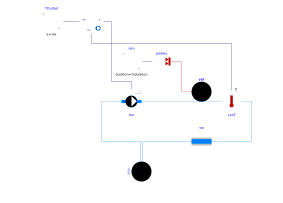
Validation model for Buildings.Fluid.DataCenters.Racks.BaseClasses.ControlledFan.
Air at 20°C is driven by the fan through a pressure drop element and a mixing volume.
The mixing volume receives a heat input that ramps from zero to
Q_flow_nominal, which corresponds to a temperature rise of 10 K
at the nominal mass flow rate,
corresponding to a face velocity of 0.2 m/s across a 2 m2 surface.
When the heat input reaches its maximum value,
the fan runs at full speed (y = 1)
and consume PFan_nominal of electrical power.
Note that the leaving fluid temperature is slightly above its set point because
the heat of the fan is added to the air flow rate, and hence the
20°C is not quite sufficient to provide the cooling required to meet the set point
temperature.
Parameters
| Type | Name | Default | Description |
|---|---|---|---|
| Modelica.Units.SI.Power | PFan_nominal | 400 | Fan nominal power |
| Modelica.Units.SI.Temperature | T_start | 293.15 | Inlet air temperature (20 degC) |
| Modelica.Units.SI.Temperature | TAirOutSet | T_start + 10 | Controller set point, inlet temperature plus 10 K |
Components
| Type | Name | Default | Description |
|---|---|---|---|
| Buildings.Fluid.DataCenters.Racks.FanControllers.OutletTemperature | con | Fan controller | |
| Buildings.Fluid.DataCenters.Racks.BaseClasses.Fan | fan | Controlled fan | |
| Buildings.Fluid.FixedResistances.PressureDrop | res | Flow resistance | |
| Buildings.Fluid.MixingVolumes.MixingVolume | vol | Mixing volume representing rack air | |
| Buildings.Fluid.Sensors.TemperatureTwoPort | senT | Outlet air temperature sensor | |
| Buildings.Fluid.Sources.Boundary_pT | sou | Pressure and temperature boundary | |
| Modelica.Thermal.HeatTransfer.Sources.PrescribedHeatFlow | preHea | Prescribed heat flow rate | |
| Modelica.Blocks.Sources.Ramp | ram | Heat flow ramp from 0 to Q_flow_nominal |
Contents
| Name | Description |
|---|---|
 Medium Medium | Air medium |
Revisions
-
September 15, 2026, by Michael Wetter:
First implementation.