 .Buildings.Fluid.HydronicConfigurations.ActiveNetworks.Examples.ThrottleOpenLoop .Buildings.Fluid.HydronicConfigurations.ActiveNetworks.Examples.ThrottleOpenLoop
This model represents a heating system where the configuration Buildings.Fluid.HydronicConfigurations.ActiveNetworks.Throttle is used to modulate the heat flow rate transmitted to a constant load. Two identical secondary circuits are connected to a primary circuit with a variable speed pump. The pump speed is modulated to track a constant pressure differential at the boundaries of the remote circuit. The main assumptions are enumerated below.
time = 0 are defined
without considering any load diversity.is_bal is set to true.When simulated with the default parameter values, this example shows the following points.
is_bal=false), the overflow in the circuit that is
the closest to the pump is about 20% (see plot #2). However,
the corresponding flow shortage in the remote circuit is limited to
about 2% due to equivalent flow resistance seen by the pump
that is lower than design, shifting the operating point towards
higher flow rates (see plot #5). The impact on the heat flow rate
transferred to the load (see plot #4) is of an even lower amplitude
(1%) due to the emission characteristic of the terminal
unit.is_bal=true), the flow shortage in the circuit that
is the closest to the pump is more significant, nearing 20%
when the remote circuit has no demand (see plot #2). The impact on
the heat flow rate transferred to the load (see plot #4) becomes
tangible (8%) while still being not critical.Those observations are confirmed by a sensitivity study to the following parameters.
is_bal switched from
false to trueWhen the circuits are not balanced, Figure 1 shows that the overflow through the terminal unit closest to the pump may reach 100% of the design flow rate for low values of ψ and β. However, the concomitant flow shortage in the other terminal unit with a valve fully open is limited to about 40% and the coil capacity is reduced by less than 20% (see Figure 2). A good valve authority (higher than 0.5) does not help improving the situation.
When the circuits are balanced, the overflow is eliminated but the flow shortage is even higher (reaching 60%) and becomes critical with respect to the coil capacity that gets reduced by nearly 40%. A good valve authority (higher than 0.5) slightly helps improving the situation, which remains worse than in the case of unbalanced circuits though.
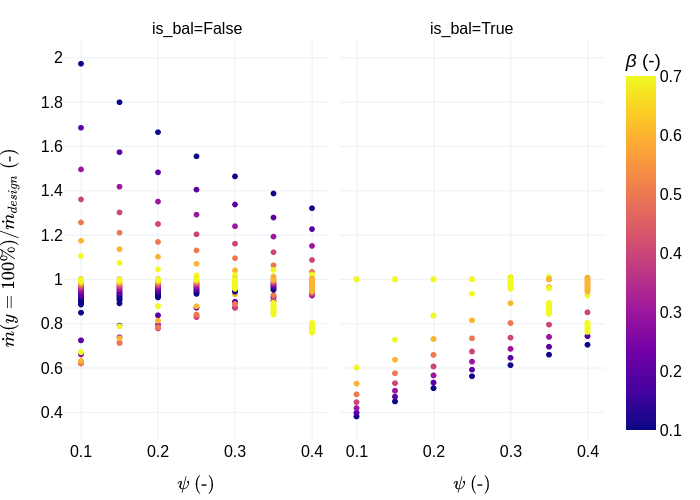
Figure 1. Valve mass flow rate (ratio to design value) at fully
open conditions as a function of ψ for various valve authorities β
(color scale), and a circuit either balanced (right plot) or not
(left plot).
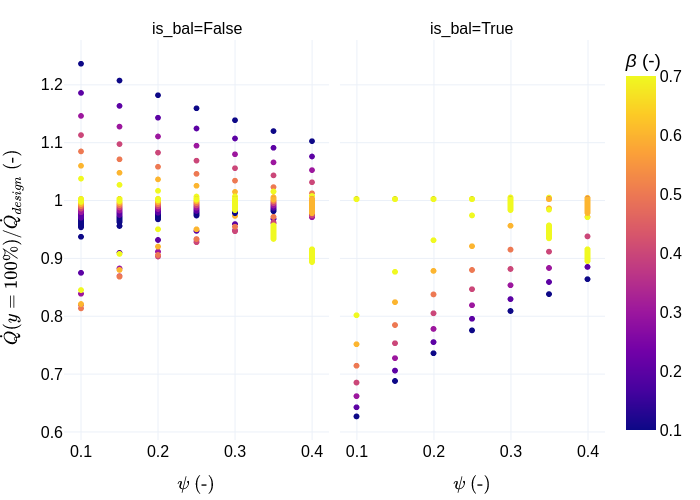
Figure 2. Heat flow rate (ratio to design value) at fully open
conditions as a function of ψ for various valve authorities β
(color scale), and a circuit either balanced (right plot) or not
(left plot).