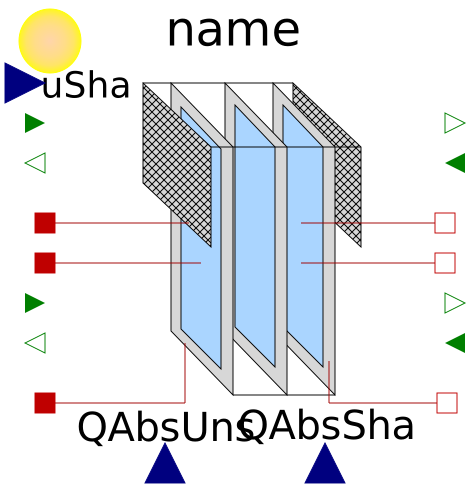
 .Buildings.HeatTransfer.Windows.Window .Buildings.HeatTransfer.Windows.Window
This is a model for a window system. The equations are similar to the equations used in the Window 5 model and described in TARCOG 2006. The model computes the heat balance from the exterior surface to the room-facing surface for a window system. The window system can have an exterior or an interior shade, but not both, or it can have no shade. The convective heat transfer between the window system and the outside air or the room is not computed by this model. They can be computed using the models Buildings.HeatTransfer.Windows.ExteriorHeatTransfer, Buildings.HeatTransfer.Windows.InteriorHeatTransferConvective and Buildings.HeatTransfer.Windows.BaseClasses.ShadeRadiation.
To calculate the angular transmittance, reflectance and absorptance of a glazing system, Window 5 model first calculates the value for each wave length, then calculate the weighted value over entire wave lengths. Current window model in Buildings library only uses the weighted value of each glass. As a result, there are some differences in prediciton between the current Modelica window model and WINDOW 5. The difference is small for single layer window or multi-layer window with the same glasses. But it can be large for multi-layer window with different glasses.
This model takes as the parameter glaSys a data
record from the package Buildings.HeatTransfer.Data.GlazingSystems.
This data record specifies the properties of the glasses, the gas
fills, the frame and of the shades, if any shade is present.
Whether a shade is present or not is determined by the parameters
glaSys.haveExteriorShade and
glaSys.haveInteriorShade.
The parameter linearize can be used to linearize
the model equations.
If the parameter steadyState is set to
false then state variables are added at the heat ports
that face the room side. For simulation of Buildings.ThermalZones.Detailed.MixedAir,
adding states avoids large nonlinear system of equations, and
generally leads to faster simulation. Default values are used for
the states.
If a shade is present, then the input port u is
used to determine the shade position. Set u=0 to have
the window in the unshaded mode, and set u=1 to have
the window shade completely deployed. Any intermediate value is
possible. If no shade is present, then this port will be
removed.
For the heat ports, the suffix _a is used for the
exterior, outside-facing side of the window, and the suffix
_b is used for the interior, room-facing surface of
the window. Each side has heat ports that connect to the glass, to
the frame, and, optionally, to the shade. If no shade is present,
then the heat port to the shade will be removed.
The model has three main submodels that implement the relevant heat balances:
frame computes heat conduction through
the frame.glaUns computes the heat balance of the
part of the window that is unshaded. For example, if
u=0.2, then this model accounts for the 80% of the
window that is not behind the shade or blind.glaSha computes the heat balance of the
part of the window that is shaded. For example, if
u=0.2, then this model accounts for the 20% of the
window that is behind the shade or blind. If the parameter
glaSys specifies that the window has no exterior and
no interior shade, then the model glaSha will be
removed.The models glaUns and glaSha compute
the solar radiation that is absorbed by each glass pane and the
solar radiation that is transitted through the window as a function
of the solar incidence angle. They then compute a heat balance that
takes into account heat conduction through the glass, heat
convection through the gas layer, and infrared radiation from the
exterior and the room through the glass and gas layers. The
infrared radiative heat exchange is computed using a radiosity
balance. Heat conduction through the frame is computed using a heat
flow path that is parallel to the glazing system, i.e., there is no
heat exchange between the frame and the glazing layer.
The window model has been validated by using measurement data at LBNL's Test Cell 71T and by using a comparative model validation with the WINDOW 6 program. These validations are described in Nouidui et al. (2012). The window model has also been validated as part of the BESTEST validations that are implemented in Buildings.ThermalZones.Detailed.Examples.BESTEST.
TARCOG 2006: Carli, Inc., TARCOG: Mathematical models for calculation of thermal performance of glazing systems with or without shading devices, Technical Report, Oct. 17, 2006.
Thierry Stephane Nouidui, Michael Wetter, and Wangda Zuo. Validation of the window model of the Modelica Buildings library. Proc. of the 5th SimBuild Conference, Madison, WI, USA, August 2012.
frame.dT to avoid a warning
about missing start value in OCT when translating
Buildings.Examples.VAVReheat.Guideline36.homotopyInitialization to a constant.homotopyInitialization.Evaluate=true.