modelCoilRegister
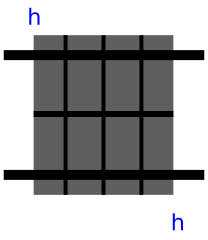
Register for a heat exchanger
Extends from Buildings.Fluid.Interfaces.FourPortFlowResistanceParameters (Parameters for flow resistance for models with four ports).
Information
Register of a heat exchanger with dynamics on the fluids and the solid. The register represents one array of pipes that are perpendicular to the air stream. The hA value for both fluids is an input. The driving force for the heat transfer is the temperature difference between the fluid volumes and the solid in each heat exchanger element.
Parameters
| Type | Name | Default | Description |
|---|---|---|---|
| Integer | nPipPar | 2 | Number of parallel pipes in each register |
| Integer | nPipSeg | 3 | Number of pipe segments per register used for discretization |
| Integer | nEle | nPipPar*nPipSeg | Number of heat exchanger elements |
| Flow resistance › Medium 1 | |||
| Boolean | computeFlowResistance1 (from FourPortFlowResistanceParameters) | true | =true, compute flow resistance. Set to false to assume no friction |
| Boolean | from_dp1 (from FourPortFlowResistanceParameters) | false | = true, use m_flow = f(dp) else dp = f(m_flow) |
| Real | n1 (from FourPortFlowResistanceParameters) | 2 | Flow exponent for side 1, n=1 for laminar, n=2 for turbulent |
| Boolean | linearizeFlowResistance1 (from FourPortFlowResistanceParameters) | false | = true, use linear relation between m_flow and dp for any flow rate |
| Real | deltaM1 (from FourPortFlowResistanceParameters) | 0.1 | Fraction of nominal flow rate where flow transitions to laminar |
| Nominal condition | |||
| Modelica.Units.SI.PressureDifference | dp1_nominal (from FourPortFlowResistanceParameters) | Pressure difference | |
| Modelica.Units.SI.PressureDifference | dp2_nominal (from FourPortFlowResistanceParameters) | Pressure difference | |
| Modelica.Units.SI.ThermalConductance | UA_nominal | Thermal conductance at nominal flow, used to compute time constant | |
| Modelica.Units.SI.MassFlowRate | m1_flow_nominal | Mass flow rate medim 1 | |
| Modelica.Units.SI.MassFlowRate | m2_flow_nominal | Mass flow rate medium 2 | |
| Modelica.Units.SI.Time | tau1 | 20 | Time constant at nominal flow for medium 1 |
| Modelica.Units.SI.Time | tau2 | 1 | Time constant at nominal flow for medium 2 |
| Modelica.Units.SI.Time | tau_m | 60 | Time constant of metal at nominal UA value |
| Flow resistance › Medium 2 | |||
| Boolean | computeFlowResistance2 (from FourPortFlowResistanceParameters) | true | =true, compute flow resistance. Set to false to assume no friction |
| Boolean | from_dp2 (from FourPortFlowResistanceParameters) | false | = true, use m_flow = f(dp) else dp = f(m_flow) |
| Real | n2 (from FourPortFlowResistanceParameters) | 2 | Flow exponent for side 2, n=1 for laminar, n=2 for turbulent |
| Boolean | linearizeFlowResistance2 (from FourPortFlowResistanceParameters) | false | = true, use linear relation between m_flow and dp for any flow rate |
| Real | deltaM2 (from FourPortFlowResistanceParameters) | 0.1 | Fraction of nominal flow rate where flow transitions to laminar |
| Advanced | |||
| Boolean | initialize_p1 | not Medium1.singleState | Set to true to initialize the pressure of volume 1 |
| Boolean | initialize_p2 | not Medium2.singleState | Set to true to initialize the pressure of volume 2 |
| Assumptions | |||
| Boolean | allowFlowReversal1 | true | = true to allow flow reversal in medium 1, false restricts to design direction (port_a -> port_b) |
| Boolean | allowFlowReversal2 | true | = true to allow flow reversal in medium 2, false restricts to design direction (port_a -> port_b) |
| Dynamics › Conservation equations | |||
| Modelica.Fluid.Types.Dynamics | energyDynamics | Modelica.Fluid.Types.Dynamics.DynamicFreeInitial | Default formulation of energy balances |
Connectors
| Type | Name | Default | Description |
|---|---|---|---|
| Modelica.Fluid.Interfaces.FluidPort_a | port_a1 | Fluid connector a for medium 1 (positive design flow direction is from port_a1 to port_b1) | |
| Modelica.Fluid.Interfaces.FluidPort_b | port_b1 | Fluid connector b for medium 1 (positive design flow direction is from port_a to port_b) | |
| Modelica.Fluid.Interfaces.FluidPort_a | port_a2 | Fluid connector a for medium 2 (positive design flow direction is from port_a2 to port_b2) | |
| Modelica.Fluid.Interfaces.FluidPort_b | port_b2 | Fluid connector b for medium 2 (positive design flow direction is from port_a to port_b) | |
| Modelica.Thermal.HeatTransfer.Interfaces.HeatPort_a[nPipPar,nPipSeg] | heaPor1 | Heat port for heat exchange with the control volume 1 | |
| Modelica.Thermal.HeatTransfer.Interfaces.HeatPort_a[nPipPar,nPipSeg] | heaPor2 | Heat port for heat exchange with the control volume 2 | |
| Modelica.Blocks.Interfaces.RealInput | Gc_2 | Signal representing the convective thermal conductance medium 2 in [W/K] | |
| Modelica.Blocks.Interfaces.RealInput | Gc_1 | Signal representing the convective thermal conductance medium 1 in [W/K] |
Components
| Type | Name | Default | Description |
|---|---|---|---|
| Buildings.Fluid.HeatExchangers.BaseClasses.HexElementSensible[nPipPar,nPipSeg] | ele | ||
| Modelica.Units.SI.HeatFlowRate | Q1_flow | Heat transferred from solid into medium 1 | |
| Modelica.Units.SI.HeatFlowRate | Q2_flow | Heat transferred from solid into medium 2 |
Contents
| Name | Description |
|---|---|
 Medium1 Medium1 | Medium 1 in the component |
| Medium2 | Medium 2 in the component |
Revisions
-
October 19, 2017, by Michael Wetter:
Changed initialization of pressure from aconstantto aparameter.
This is for Buildings, issue 1013. -
February 5, 2015, by Michael Wetter:
Changedinitalize_pfrom aparameterto aconstant. This is only required in finite volume models of heat exchangers (to avoid consistent but redundant initial conditions) and hence it should be set as aconstant. -
December 22, 2014 by Michael Wetter:
RemovedModelica.Fluid.Systemto address issue #311. -
August 10, 2014, by Michael Wetter:
Reformulated the multiple iterators in thesumfunction as this language construct is not supported in OpenModelica. -
July 3, 2014, by Michael Wetter:
Added parametersinitialize_p1andinitialize_p2. This is required to enable the coil models to initialize the pressure in the first volume, but not in the downstream volumes. Otherwise, the initial equations will be overdetermined, but consistent. This change was done to avoid a long information message that appears when translating models. -
June 26, 2014, by Michael Wetter:
Removed parametersenergyDynamics1andenergyDynamics2, and used instead of these two parameters the new parameterenergyDynamics. Removed parameterssteadyState_1andsteadyState_2. This was done as this complexity is not required. -
August 12, 2008 by Michael Wetter:
Introduced option to compute each medium using a steady state model or a dynamic model. -
March 25, 2008, by Michael Wetter:
First implementation.