
modelFlatPlateWithTank
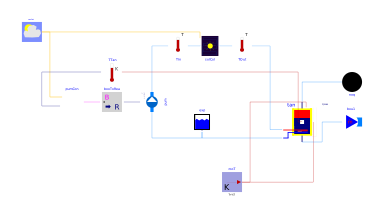
Extends from Modelica.Icons.Example (Icon for runnable examples).
Information
This example shows how several different models can be combined to create an entire solar water heating system. The Buildings.Fluid.Storage.StratifiedEnhancedInternalHex (tan) model is used to represent the tank filled with hot water. A loop, powered by a pump ( Buildings.Fluid.Movers.FlowControlled_m_flow, pum), passes the water through an expansion tank ( Buildings.Fluid.Storage.ExpansionVessel, exp), a temperature sensor ( Buildings.Fluid.Sensors.TemperatureTwoPort, TIn), the solar collector ( Buildings.Fluid.SolarCollectors.ASHRAE93, solCol), and a second temperature sensor ( Buildings.Fluid.Sensors.TemperatureTwoPort, TOut) before re-entering the tank.
The solar collector is connected to the weather model ( Buildings.BoundaryConditions.WeatherData.ReaderTMY3, weaDat) which passes information for the San Francisco, CA, USA climate. This information is used to identify both the heat gain in the water from the sun and the heat loss to the ambient conditions.
The flow rate through the pump is controlled by a solar pump controller model ( Buildings.Fluid.SolarCollectors.Controls.CollectorPump, pumCon) and a gain model. The controller outputs a binary on (1) / off (0) signal. The on/off signal is passed through a boolean to real signal converter to set the pump mass flow rate.
The heat ports for the tank are connected to an ambient temperature of 20 degrees C representing the temperature of the room the tank is stored in.
bou1 ( Buildings.Fluid.Sources.MassFlowSource_T) provides a constant mass flow rate for a hot water draw while bou ( Buildings.Fluid.Sources.Boundary_pT) provides a boundary condition for the outlet of the draw.
Parameters
| Type | Name | Default | Description |
|---|---|---|---|
| Modelica.Units.SI.Angle | azi | 0.3 | Surface azimuth (0 for south-facing; -90 degree for east-facing; +90 degree for west facing |
| Modelica.Units.SI.Angle | til | 0.78539816339745 | Surface tilt (0 for horizontally mounted collector) |
| Real | rho | 0.2 | Ground reflectance |
| Modelica.Units.SI.MassFlowRate | m_flow_nominal | solCol.m_flow_nominal | Nominal mass flow rate |
Components
Contents
| Name | Description |
|---|---|
 Medium Medium | Fluid in the storage tank |
| Medium_2 | Fluid flowing through the collector |
Revisions
-
February 15, 2024, by Jelger Jansen:
Refactor model.
This is for Buildings, #3604. -
November 7, 2022, by Michael Wetter:
Revised example to provide values for new parameters and to integrate the revised solar pump controller.
This is for issue 3074. -
September 16, 2021, by Michael Wetter:
Removed parameter assignment forlat.
This is for IBPSA, #1477. -
December 22, 2014 by Michael Wetter:
RemovedModelica.Fluid.Systemto address issue #311. -
April 18, 2014, by Michael Wetter:
Updated model to use the revised tank and increased the tank height. -
March 25, 2014, by Michael Wetter:
Updated model with new expansion vessel. -
March 27, 2013 by Peter Grant:
First implementation