modelPartialChillerBorefield

Partial validation of the ETS model with heat recovery chiller and optional borefield
Extends from Modelica.Icons.Example (Icon for runnable examples).

Information

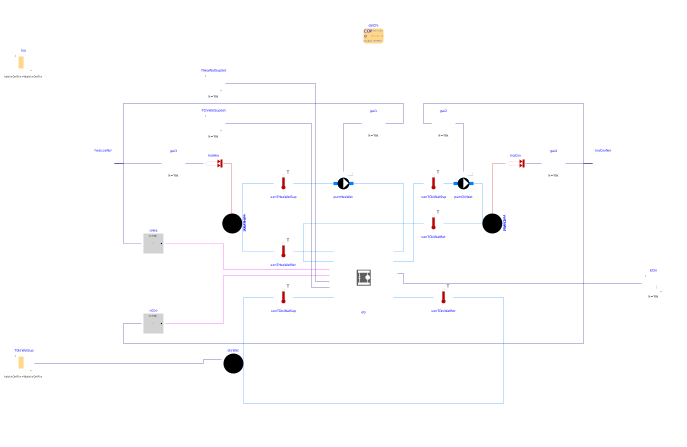
This is a partial model used as a base class to construct the validation and example models.

  • The building distribution pumps are variable speed and the flow rate is considered to vary linearly with the load (with no inferior limit).
  • The Boolean enable signals for heating and cooling typically provided by the building automation system are here computed based on the condition that the load is greater than 1% of the nominal load.
  • Simplified chiller performance data are used, which represent a linear variation of the EIR and the capacity with the evaporator outlet temperature and the condenser inlet temperature (no variation of the EIR at part load is considered).

Parameters

TypeNameDefaultDescription
Modelica.Units.SI.MassFlowRatemHeaWat_flow_nominal0.9*datChi.mCon_flow_nominalNominal heating water mass flow rate
Modelica.Units.SI.MassFlowRatemChiWat_flow_nominal0.9*datChi.mEva_flow_nominalNominal chilled water mass flow rate
Buildings.Fluid.Chillers.Data.ElectricEIR.GenericdatChiChiller performance data
Design parameter
Modelica.Units.SI.HeatFlowRateQCoo_flow_nominal-1e6Design cooling heat flow rate (<=0)
Modelica.Units.SI.HeatFlowRateQHea_flow_nominalabs(QCoo_flow_nominal)*(1 + 1/datChi.COP_nominal)Design heating heat flow rate (>=0)

Components

TypeNameDefaultDescription
Buildings.Controls.OBC.CDL.Reals.Sources.ConstantTHeaWatSupSetHeating water supply temperature set point
Buildings.Controls.OBC.CDL.Reals.Sources.ConstantTChiWatSupSetChilled water supply temperature set point
Buildings.Fluid.Sensors.TemperatureTwoPortsenTHeaWatSupHeating water supply temperature
Buildings.Fluid.Sensors.TemperatureTwoPortsenTChiWatSupChilled water supply temperature
Buildings.Obsolete.DHC.ETS.Combined.ChillerBorefieldetsETS
Buildings.Fluid.Sensors.TemperatureTwoPortsenTHeaWatRetHeating water return temperature
Buildings.Fluid.Sensors.TemperatureTwoPortsenTChiWatRetChilled water return temperature
Buildings.Fluid.Sources.Boundary_pTdisWatDistrict water boundary conditions
Buildings.DHC.ETS.BaseClasses.Pump_m_flowpumChiWatChilled water distribution pump
Buildings.Controls.OBC.CDL.Reals.MultiplyByParametergai2Scale to nominal mass flow rate
Buildings.Controls.OBC.CDL.Reals.MultiplyByParametergai1Scale to nominal mass flow rate
Buildings.DHC.ETS.BaseClasses.Pump_m_flowpumHeaWatHeating water distribution pump
Buildings.Fluid.MixingVolumes.MixingVolumevolHeaWatVolume for heating water distribution circuit
Buildings.Controls.OBC.CDL.Reals.MultiplyByParametergai3Scale to nominal heat flow rate
Buildings.HeatTransfer.Sources.PrescribedHeatFlowloaHeaHeating load as prescribed heat flow rate
Buildings.Fluid.MixingVolumes.MixingVolumevolChiWatVolume for chilled water distribution circuit
Buildings.Controls.OBC.CDL.Reals.MultiplyByParametergai4Scale to nominal heat flow rate
Buildings.HeatTransfer.Sources.PrescribedHeatFlowloaCooCooling load as prescribed heat flow rate
Buildings.Controls.OBC.CDL.Reals.GreaterThresholduHeaEnable heating
Buildings.Controls.OBC.CDL.Reals.GreaterThresholduCooEnable cooling
Modelica.Blocks.Routing.RealPassThroughheaLoaNorConnect with normalized heating load
Modelica.Blocks.Routing.RealPassThroughloaCooNorConnect with normalized cooling load
Modelica.Blocks.Sources.CombiTimeTableTDisWatSupDistrict water supply temperature
Modelica.Blocks.Sources.CombiTimeTableloaThermal loads (y[1] is cooling load, y[2] is heating load)
Buildings.Fluid.Sensors.TemperatureTwoPortsenTDisWatSupDistrict water supply temperature
Modelica.Blocks.Continuous.IntegratorEChiChiller electricity use
Buildings.Fluid.Sensors.TemperatureTwoPortsenTDisWatRetDistrict water return temperature

Contents

NameDescription
MediumMedium model

Revisions

  • March 6, 2025, by Hongxiang Fu:
    Revised load curves so that the heating and cooling loads can be staggered instead of always appearing and disappearing at the same time.
    This is for #4133.
  • July 31, 2020, by Antoine Gautier:
    First implementation.