
modelExteriorWall
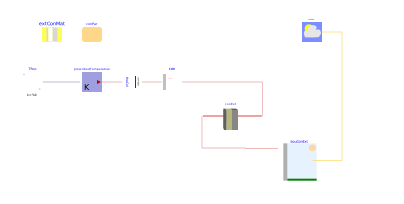
Test model for an exterior wall without a window
Extends from Modelica.Icons.Example (Icon for runnable examples).
Information
This model tests the exterior construction without windows.
Parameters
| Type | Name | Default | Description |
|---|---|---|---|
| HeatTransfer.Data.OpaqueConstructions.Insulation100Concrete200 | extConMat | Record for material layers | |
| Buildings.ThermalZones.Detailed.BaseClasses.ParameterConstruction[1] | conPar | Data for construction |
Components
| Type | Name | Default | Description |
|---|---|---|---|
| Buildings.ThermalZones.Detailed.Constructions.Construction[1] | conExt | Construction of an exterior wall without a window | |
| Buildings.ThermalZones.Detailed.BaseClasses.ExteriorBoundaryConditions | bouConExt | Exterior boundary conditions for constructions without a window | |
| Buildings.HeatTransfer.Sources.PrescribedTemperature | prescribedTemperature | ||
| Buildings.HeatTransfer.Convection.Interior[1] | con | Model for heat convection | |
| Modelica.Thermal.HeatTransfer.Components.ThermalCollector | theCol | Thermal collector to link a vector of models to a single model | |
| BoundaryConditions.WeatherData.ReaderTMY3 | weaDat | ||
| Modelica.Blocks.Sources.Constant | TRoo | Room air temperature |
Revisions
-
September 16, 2021, by Michael Wetter:
Removed assignment of parameterlatas this is now obtained from the weather data reader.
This is for IBPSA, #1477. -
November 17, 2016, by Thierry S. Nouidui:
Removed[:]inconPar.layersto avoid translation error in Dymola 2107. This is a work-around for a bug in Dymola which will be addressed in future releases. -
April 29, 2013, by Michael Wetter:
Corrected wrong assignment of parameter in instancebouConExt(conMod=...)which was set to an interior instead of an exterior convection model. -
May 1, 2013, by Michael Wetter:
Declared the parameter record to be a parameter, as declaring its elements to be parameters does not imply that the whole record has the variability of a parameter. -
March 7, 2012, by Michael Wetter:
Updated example to use new data model Buildings.ThermalZones.Detailed.BaseClasses.ParameterConstruction in model for boundary conditions. -
December 6, 2010, by Michael Wetter:
First implementation.