blockflow_control
Information
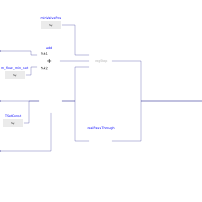
Control function that sets the position of a valve/pump in order to reach a desired temperature at the measurement point of the input. The main use case for this controller is actuating the valve/pump at the primary side of a district heating substation in a way to keep the temperature at the secondary side at a setpoint. A PI-control function is used to determine the desired valve/pump position. A minimum value can be set for the output to, e.g., mimic a bypass. The output y is in the range [min_y, 1], thus, when a pump is used the value needs to be multiplied by the nominal mass flow value.
If use_T_in is true the temperature set-point is taken from the input T_set else from the constant T_const.
If use_m_flow_in is true the mass flow measurement signal is used to set the valve/pump set-point to its minimum position in times of small mass flows m_flow_min.
Parameters
| Type | Name | Default | Description |
|---|---|---|---|
| Boolean | reverseAction | false | Set to true for reversed PI controller (error term decreases output) |
| Real | k | 0.01 | Gain of controller |
| Modelica.SIunits.Time | Ti | 120 | Time constant of Integrator block |
| Real | min_y | 0.0 | Minimum valve position (e.g., bypass) |
| Boolean | use_T_in | false | Use input for temperature setpoint |
| Boolean | use_m_flow_in | false | Use minimum valve/pump position in case of small mass flow |
| Modelica.SIunits.Temperature | T_const | 60.0 + 273.15 | Constant temperature setpoint |
| Modelica.SIunits.MassFlowRate | m_flow_nominal | 0 | Nominal mass flow rate at secondary side |
| Modelica.SIunits.MassFlowRate | m_flow_min | 0.0001*abs(m_flow_nominal) | Mass flow rate at secondary side where minimum valve/pump position is set |
Connectors
| Type | Name | Default | Description |
|---|---|---|---|
| Modelica.Blocks.Interfaces.RealInput | T_set | Input signal connector | |
| Modelica.Blocks.Interfaces.RealOutput | y | Connector of Real output signal | |
| Modelica.Blocks.Interfaces.RealInput | m_flow_measurement | Input signal connector | |
| Modelica.Blocks.Interfaces.RealInput | T_measurement | Input signal connector |
Components
| Type | Name | Default | Description |
|---|---|---|---|
| IBPSA.Controls.Continuous.LimPID | conPID |
Revisions
- Feburary 27, 2019, by Benedikt Leitner:
Implementation and added User's guide.