modelMove

Extends from Modelica.Mechanics.Translational.Interfaces.PartialElementaryOneFlangeAndSupport2 (Partial model for a component with one translational 1-dim. shaft flange and a support used for textual modeling, i.e., for elementary models).
Information
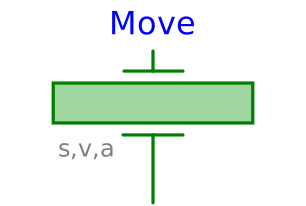
Flange flange is forced to move relative to the support connector with a predefined motion according to the input signals:
u[1]: position of flange
u[2]: velocity of flange
u[3]: acceleration of flange
The user has to guarantee that the input signals are consistent to each other, i.e., that u[2] is the derivative of u[1] and that u[3] is the derivative of u[2]. There are, however, also applications where by purpose these conditions do not hold. For example, if only the position dependent terms of a mechanical system shall be calculated, one may provide position = position(t) and set the velocity and the acceleration to zero.
The input signals can be provided from one of the signal generator blocks of the block library Modelica.Blocks.Sources.
Parameters
| Type | Name | Default | Description |
|---|---|---|---|
| Boolean | useSupport (from PartialElementaryOneFlangeAndSupport2) | false | = true, if support flange enabled, otherwise implicitly grounded |
Connectors
| Type | Name | Default | Description |
|---|---|---|---|
| Flange_b | flange (from PartialElementaryOneFlangeAndSupport2) | Flange of component | |
| Support | support (from PartialElementaryOneFlangeAndSupport2) | Support/housing of component | |
| Modelica.Blocks.Interfaces.RealInput[3] | u | Position, velocity and acceleration of flange as input signals |
Components
| Type | Name | Default | Description |
|---|---|---|---|
| SI.Length | s (from PartialElementaryOneFlangeAndSupport2) | Distance between flange and support (= flange.s - support.s) |
Contents
| Name | Description |
|---|---|
 positionprotected positionprotected | |
 position_derprotected position_derprotected | |
 position_der2protected position_der2protected |