modelPK_3M_3C
Extends from Icons.Compound.
Information
PK_3M_3C
Generic template for a pro-drug with up to two metabolites (e.g. clopidogrel: active thiol metabolite H4 and inactive carboxylic acid; Jung 2024). A concrete drug model extends it and sets parameters; covariate and genotype effects are ordinary parameter expressions in the extending model (e.g. q1_m11 = fm1*fm2*CLC).
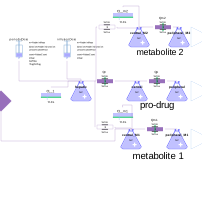
Structure. The dose is absorbed (ka, Tlag, F) into the hepatic compartment (first pass). The parent distributes hepatic ↔ central ↔ peripheral. Both metabolites are formed in the hepatic compartment, each into its own central compartment with an optional peripheral compartment.
Naming. qXY is the clearance moving drug from compartment X to Y: 1, 2, 3 = parent hepatic, central, peripheral; m11, m12 = metabolite 1 central, peripheral; m21, m22 = metabolite 2 central, peripheral. q1_m11 and q1_m21 are formation clearances. CL1 removes the parent by all other routes.
Reducing the structure (every parameter defaults to 0, and an unused compartment simply stays empty):
- only one metabolite: leave
q1_m21 = 0(and the M2 volumes at 0); - a 1-compartment metabolite: leave its peripheral clearances at 0 (
qm11_m12 = qm12_m11 = 0orqm21_m22 = qm22_m21 = 0); - a parent without a peripheral compartment:
q23 = q32 = 0.
Dosing through two sources sharing one schedule (adminTime, adminPeriod, adminCount): oral adminMass enters the hepatic compartment (ka, Tlag, F, adminDuration), so it passes the liver — and forms metabolites — before reaching the circulation; IV / parenteral infusionMass enters the hepatic compartment as well (bioavailability 1, infused over infusionDuration, no absorption step), so it also passes hepatic metabolism before reaching the central compartment. Use one and set the other to 0: adminMass defaults to 100 mg, so an IV-only model sets adminMass = 0; infusionMass defaults to 0. Both may be non-zero for a regimen that combines the routes.
Molar masses. Formation is molar: 1 mol of parent forms 1 mol of metabolite, so with the molar masses set (MW, MW_m1, MW_m2, kg/mol) the metabolite gains MW_m/MW kg per kg of parent converted (TransferMetabolicConversion). Every compartment then also reports its molar concentration C_molar (mol/m3). A molar mass left at 0 means "not supplied": formation falls back to mass-conserving (ratio 1) and C_molar is 0.
Assumptions and limits. Metabolite formation happens only in the hepatic compartment; a model forming metabolites from the central compartment, or giving the parent IV into the central compartment, does not fit this template unchanged.
Outputs: C_central (parent), C_M1, C_M2, and the connector centralM1CPort (metabolite 1 central compartment) for driving a PD model.
Simulating as a co-simulation FMU
The dose is a rectangular pulse adminMass/adminDuration wide adminDuration. An OpenModelica co-simulation FMU (CVODE, no root finding) sees that pulse only at communication points, so the communication step must resolve it: use at most adminDuration/50 and keep dose times on the step grid. Measured on PK_3M_3C (single 75 mg dose): with a 60 s step a 1 s pulse was either missed (0× the dose) or held for the whole step (60×); with adminDuration/50 the mass balance closes to 1.0000. A pulse that starts at t = 0 or between grid points is held one step too long (+2% at adminDuration/50), which is why the templates start at adminTime = 60. In FMPy the communication step is output_interval, not step_size.
Parameters
| Type | Name | Default | Description |
|---|---|---|---|
| Real | massRatio_m1 | if MW > 0 and MW_m1 > 0 then MW_m1/MW else 1 | |
| Real | massRatio_m2 | if MW > 0 and MW_m2 > 0 then MW_m2/MW else 1 | |
| Pharmacolibrary.Types.Mass | adminMass | 1e-4 | oral dose mass, into the hepatic compartment (0 = no oral dose; an IV-only model sets 0) |
| Pharmacolibrary.Types.Mass | infusionMass | 0 | IV / parenteral dose mass into the hepatic compartment (0 = no IV dose); bioavailability 1 |
| Integer | adminCount | 1 | number of doses (-1 = unlimited) |
| Modelica.Units.SI.Time | adminPeriod | 8*3600 | period of administration |
| Modelica.Units.SI.Time | adminDuration | 1 | oral administration duration (a 1 s bolus into the gut, as in PeriodicDose_Enteral) |
| Modelica.Units.SI.Time | infusionDuration | adminDuration | IV infusion duration (default: adminDuration, i.e. a bolus) |
| Modelica.Units.SI.Time | adminTime | 60 | first administration time (s); 60 as in PK_1C, not 0 — a co-simulation FMU starting a dose pulse at t = 0 doses one communication step too long |
| Modelica.Units.SI.MassFraction | F | 1 | bioavailability (0-1) |
| Pharmacolibrary.Types.TransferRate | ka | 0.016666666666666666 | first order absorption rate |
| Modelica.Units.SI.Time | Tlag | 600 | delay between oral administration and absorption |
| Types.Volume | Vd1 | 0 | parent: hepatic (absorption) compartment volume |
| Types.Volume | Vd2 | 0 | parent: central volume |
| Types.Volume | Vd3 | 0 | parent: peripheral volume |
| Types.Volume | Vd1m1 | 0 | metabolite 1: central volume |
| Types.Volume | Vd2m1 | 0 | metabolite 1: peripheral volume (0 with qm11_m12 = qm12_m11 = 0 for a 1-compartment metabolite) |
| Types.Volume | Vd1m2 | 0 | metabolite 2: central volume |
| Types.Volume | Vd2m2 | 0 | metabolite 2: peripheral volume (0 with qm21_m22 = qm22_m21 = 0 for a 1-compartment metabolite) |
| Types.Clearance | q12 | 0 | parent: hepatic -> central |
| Types.Clearance | q21 | 0 | parent: central -> hepatic |
| Types.Clearance | q23 | 0 | parent: central -> peripheral |
| Types.Clearance | q32 | 0 | parent: peripheral -> central |
| Types.Clearance | q1_m11 | 0 | formation of metabolite 1: hepatic -> M1 central (0 = no metabolite 1) |
| Types.Clearance | qm11_1 | 0 | back-conversion: M1 central -> hepatic (usually 0) |
| Types.Clearance | qm11_m12 | 0 | metabolite 1: central -> peripheral (0 = 1-compartment metabolite) |
| Types.Clearance | qm12_m11 | 0 | metabolite 1: peripheral -> central |
| Types.Clearance | q1_m21 | 0 | formation of metabolite 2: hepatic -> M2 central (0 = no metabolite 2) |
| Types.Clearance | qm21_1 | 0 | back-conversion: M2 central -> hepatic (usually 0) |
| Types.Clearance | qm21_m22 | 0 | metabolite 2: central -> peripheral (0 = 1-compartment metabolite) |
| Types.Clearance | qm22_m21 | 0 | metabolite 2: peripheral -> central |
| Types.Clearance | CL1 | 0 | parent: elimination from hepatic compartment by routes other than M1/M2 formation |
| Types.Clearance | CLm1 | 0 | metabolite 1: elimination from central |
| Types.Clearance | CLm2 | 0 | metabolite 2: elimination from central |
| Info › Molar masses | |||
| Modelica.Units.SI.MolarMass | MW | 0 | parent molar mass [kg/mol]; 0 = not supplied |
| Modelica.Units.SI.MolarMass | MW_m1 | 0 | metabolite 1 molar mass [kg/mol]; 0 = not supplied |
| Modelica.Units.SI.MolarMass | MW_m2 | 0 | metabolite 2 molar mass [kg/mol]; 0 = not supplied |
Connectors
| Type | Name | Default | Description |
|---|---|---|---|
| Interfaces.ConcentrationPort_b | centralM1CPort | metabolite 1 central compartment (e.g. to drive a PD model) | |
| Types.ConcentrationOutput | C_central | parent concentration, central compartment | |
| Types.ConcentrationOutput | C_M1 | metabolite 1 concentration, central compartment | |
| Types.ConcentrationOutput | C_M2 | metabolite 2 concentration, central compartment |