
modelMessage

Information
We use messages to model asynchronous communication between different state graphs. Message define the type of asynchronous messages.
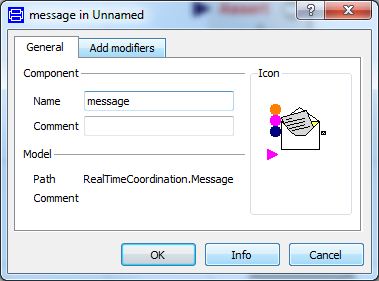
A message has parameters which transfer information from its sender to its receiver. The signature of the message type defines which parameter the message has. The parameters have a call by value semantics. The sender transition binds concrete values to the parameters which can be accessed by the receiver transition. In State Graph the defined messages can be used as raise message-events by a sender transition. A raise message-event is a message-event which is raised when a transition fires. A raise message-event is sent via the associated output delegation port of the State Graph2 class. This port is connected to an input delegation port which itself has a State Graph2 model and a receiver mailbox and a receiver transition.
Parameters
| Type | Name | Default | Description |
|---|---|---|---|
| Integer | nIn | 0 | |
| Integer | numberOfMessageIntegers | 0 | Number of Integer input connections |
| Integer | numberOfMessageReals | 0 | Number of Real input connections |
| Integer | numberOfMessageBooleans | 0 | Number of Boolean input connections |
Connectors
| Type | Name | Default | Description |
|---|---|---|---|
| Modelica.Blocks.Interfaces.BooleanInput[nIn] | conditionPort | trigger input port for sending messages | |
| Modelica_StateGraph2.Blocks.Interfaces.IntegerVectorInput[numberOfMessageIntegers] | u_integers | Integer parameters of message | |
| Modelica_StateGraph2.Blocks.Interfaces.BooleanVectorInput[numberOfMessageBooleans] | u_booleans | Boolean parameters of message | |
| Modelica_StateGraph2.Blocks.Interfaces.RealVectorInput[numberOfMessageReals] | u_reals | Real parameters of message | |
| RealTimeCoordinationLibrary.Internal.Interfaces.Asynchron.message_output_port | message_output_port | output port for sending message |