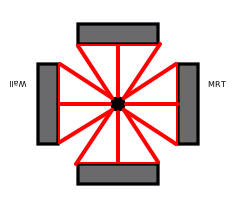
modelCarrollRadiation

Extends from Modelica.Thermal.HeatTransfer.Interfaces.Element1D (Partial heat transfer element with two HeatPort connectors that does not store energy).
Information
This component links the heat flow with a temperature difference between a wall and the Carroll node, actually the Mean Radiant Temperature (MRT), thanks to the Stefan-Boltzmann law of radiation. It incoporates the resistance calculation between the surface net flux and radiatity and the resistance induced by the form factor. The detail of the model is available in the theoretical note. The following assumptions are made:
- Wall is opaque: Their transmittivty is zero
- Kirchhoff law is supposed practical: spectral absorptivity is equal to spectral emissivity
- The surface bodies are grey: They radiative properties are thus independant from the wavelength. It implies to remains within a small range a wavelength
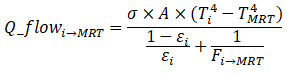
Where :
- Q_flow: Heat flow rate from connector 'wall' (e.g., a plate) to connector 'MRT' (the Carrol's Node).
- add_on is a user paramater to adjust if needed the Heat flow
- σ is Stefan-Boltzmann's constant
- A is the radiative surface area of the wall
- ε is the emissivity
- Fviewj->MRT is the form factor (or view factor) between the wall and the Carrol's Node
However, the above equation is non-linear. The idea is then to reduce this last equation to an equation of the Newton’s cooling law type. The heat transfer coefficient h_rad from the linearization of the above equation is calculated by a function.

Where :
- h_rad is the linearized heat transfer coefficient (Newton's coefficient)
- add_on is a user paramater to adjust if needed the Heat flow to the temperature difference dT
- dT is the Temperature difference between the wall (port_a.T) and port_b.T
Using a function to calculate h_rad rather than putting directly the relation between the heat flux and the temperature difference without function seems to us to allow a gain of stability. Indeed, the passage by a function seemed to us to make the calculation of the exchange coefficient explicit rather than implicit.
In addition, the transition from biquadratique to a linear relationship between the heat flux and the temperature difference makes the calculation more stable numerically
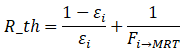
The difference between the heat flow lost or gained by the solid (the net flux) and the heat flow leaving the surface taking account of the reflectivity is seen as 'thermal resistance' R_th. This thermal resistance is given as input to the function to compute h_rad (See h_rad function description).
Parameters
| Type | Name | Default | Description |
|---|---|---|---|
| Real | add_on | 1 | Custom add-on |
| Real | sigma | Modelica.Constants.sigma | Stefan-Boltzmann constant |
| Geometrical properties | |||
| Modelica.SIunits.Area | A | 0 | Wall Surface Area |
| Radiative properties | |||
| Modelica.SIunits.Emissivity | eps | 1 | Grey wall surface emissivity |
Connectors
| Type | Name | Default | Description |
|---|---|---|---|
| HeatPort_a | port_a (from Element1D) | ||
| HeatPort_b | port_b (from Element1D) | ||
| Modelica.Blocks.Interfaces.RealInput | Fview |
Components
| Type | Name | Default | Description |
|---|---|---|---|
| SI.HeatFlowRate | Q_flow (from Element1D) | Heat flow rate from port_a -> port_b | |
| SI.TemperatureDifference | dT (from Element1D) | port_a.T - port_b.T | |
| Modelica.SIunits.CoefficientOfHeatTransfer | h_rad | Heat transfer coefficient | |
| Modelica.SIunits.Energy | E | Energy passed throught the component |