
modelACLine_RLC_N
Extends from Modelica.Icons.Example (Icon for runnable examples).
Information
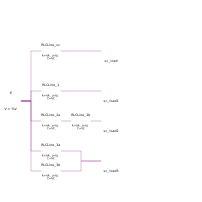
This example demonstrates how to use an RLC line model with neutral cable to connect a source to a load.
The model has four different loads. The loads sc_load,
sc_load1, sc_load2, sc_load3 represent
short circuits R=0. The current that flows through the load depends
on the resistance, inductance and capacitance of the line.
The parameter R, L and C are such that at the nominal frequency fnom = 60 Hz the respective resistance and reactances are all equal to 10 Ω.
The lines used in this example have a T model (see BuildingSystems.Electrical.AC.ThreePhasesUnbalanced.Lines.TwoPortRLC). The equivalent impedance of the line on each phase is equal to
ZEQ = R/2 +jXL/2 + (R/2 +jXL/2)(-jXC)/ (R/2 +jXL/2 -jXC)
that in this case is equal to ZEQ = 15 + j5 Ω.
Given the equivalent impedance of each phase, and a voltage with an RMS value of 100 V produces a current equal to I = 6 - j2 A flowing through phase 1.
Notes
(1) Note:
The line model RLCLine_sc is the same as RLCLine_1 but it uses
dynamic phasors.
(2) Note:
The line model RLCLine_2a has a current that is different
from the one passing in RLCLine_1 because the series of two T
line models is different from the sum of the two separate line models.
(3) Note:
The line models RLCLine_3a and RLCLine_3b have currents that are
50% of the other lines because they are in parallel.
Parameters
| Type | Name | Default | Description |
|---|---|---|---|
| Modelica.Units.SI.Resistance | RBase | 3*10 | Base value for the line resistance |
| Modelica.Units.SI.Inductance | LBase | RBase/(2*Modelica.Constants.pi*60) | Base value for the line inductances |
| Modelica.Units.SI.Capacitance | CBase | 3*0.1/(2*Modelica.Constants.pi*60) | Base value for the line inductances |
Components
| Type | Name | Default | Description |
|---|---|---|---|
| Sources.FixedVoltage_N | E | Voltage source | |
| Loads.Impedance_N | sc_load1 | Short circuit load | |
| Loads.Impedance_N | sc_load2 | Short circuit load | |
| Loads.Impedance_N | sc_load3 | Short circuit load | |
| Loads.Impedance_N | sc_load | Short circuit load | |
| Lines.TwoPortRLC_N | RLCLine_sc | RLC line that connects to the short circuit | |
| Lines.TwoPortRLC_N | RLCLine_1 | RLC line that connects to load 1 | |
| Lines.TwoPortRLC_N | RLCLine_2a | RLC line that connects to load 2 | |
| Lines.TwoPortRLC_N | RLCLine_2b | RLC line that connects to load 2 | |
| Lines.TwoPortRLC_N | RLCLine_3a | RLC line that connects to load 3 | |
| Lines.TwoPortRLC_N | RLCLine_3b | RLC line that connects to load 3 |
Revisions
-
January 14, 2015, by Marco Bonvini:
Created model and documentation.