
modelDetailedHouse4
Extends from DetailedHouse3 (Adding occupancy and lighting).
Information
This example extends the third example by adding a custom occupancy model that uses an occupancy schedule that returns an occupancy of two during office hours and zero otherwise.
Required models
- IDEAS.Buildings.Components.Occupants.BaseClasses.PartialOccupants
- IDEAS.Utilities.Time.CalendarTime
- Modelica.Blocks.Sources.RealExpression
Connection instructions
Create a new model that extends the occupancy partial model. This partial model contains an input,
which is not used, and an output, which must be set. Create an occupancy signal using a
RealExpression that returns the parameter value k during office hours (7–19 h on weekdays)
and zero otherwise. Implement this model by extending the previous example, redeclaring the
occupancy model, and setting parameter k.
Use the year 2019 (
IDEAS.Utilities.Time.Types.ZeroTime.NY2019) to define the reference time in the calendar model.
Use an if-then-else statement with
logical checks for the calendar outputs weekDay and hour.
Reference result
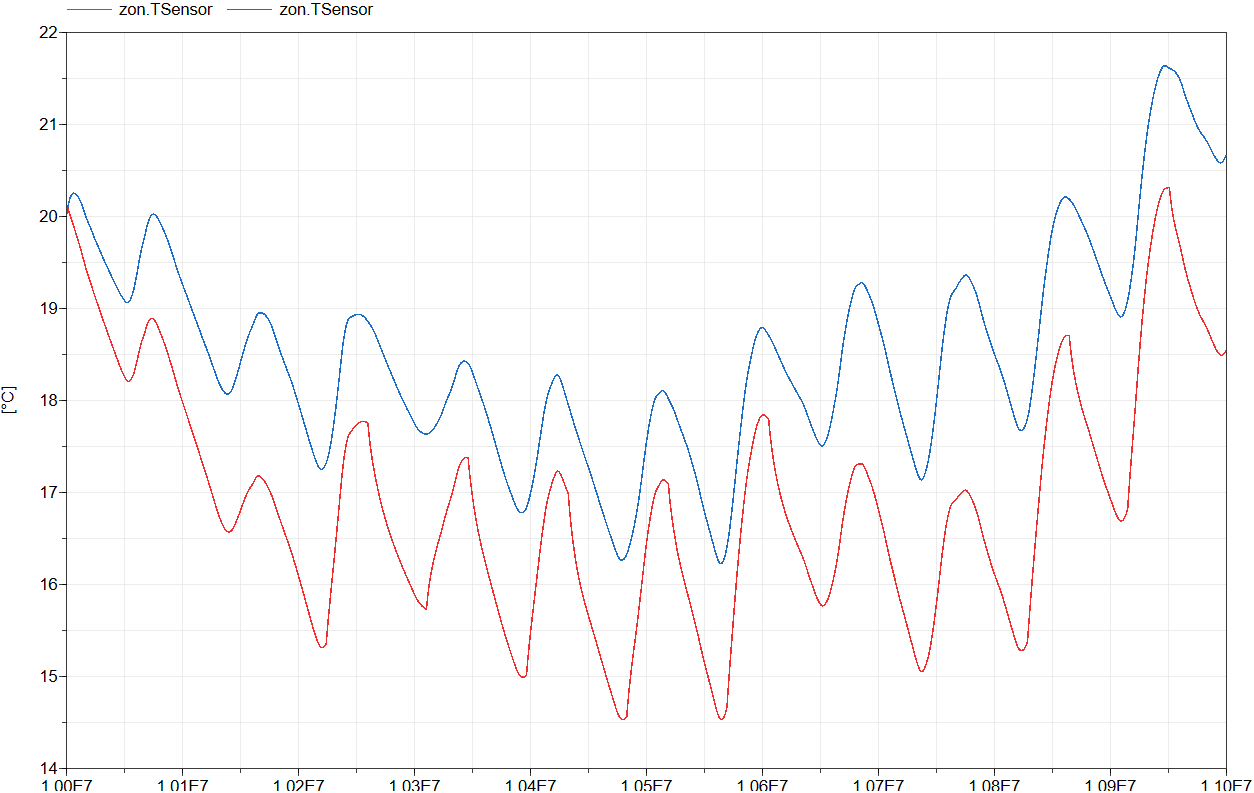
The figure below shows the operative zone temperature with the old (blue) and new (red) occupancy model. Note the much more peaked behaviour of the zone temperature during the weekdays when there are occupants present.
Parameters
| Type | Name | Default | Description |
|---|---|---|---|
| Modelica.Units.SI.Length | l (from DetailedHouse1) | 8 | Zone length |
| Modelica.Units.SI.Length | w (from DetailedHouse1) | 4 | Zone width |
| Modelica.Units.SI.Length | h (from DetailedHouse1) | zon.hZone | Zone height (Default) |
Components
| Type | Name | Default | Description |
|---|---|---|---|
| IDEAS.BoundaryConditions.SimInfoManager | sim (from DetailedHouse1) | ||
| IDEAS.Buildings.Components.Zone | zon (from DetailedHouse1) | Zone model | |
| IDEAS.Buildings.Components.OuterWall | outWalWes (from DetailedHouse1) | Western outer wall model | |
| IDEAS.Buildings.Components.OuterWall | outWalEas (from DetailedHouse1) | Eastern outer wall model | |
| IDEAS.Buildings.Components.OuterWall | outWalNor (from DetailedHouse1) | Northern outer wall model | |
| IDEAS.Buildings.Components.OuterWall | outWalSou (from DetailedHouse1) | Southern outer wall model | |
| IDEAS.Buildings.Components.Window | win (from DetailedHouse1) | Window model | |
| IDEAS.Buildings.Components.SlabOnGround | slaOnGro (from DetailedHouse1) | Floor model | |
| IDEAS.Buildings.Components.OuterWall | cei (from DetailedHouse1) | Ceiling model | |
| Modelica.Blocks.Sources.Constant | con (from DetailedHouse2) | Solar screen's external control signal |
Contents
| Name | Description |
|---|---|
 OccSchprotected OccSchprotected | Simple occupancy schedule |