 .Buildings.Fluid.FMI.ExportContainers.Validation.RoomHVAC .Buildings.Fluid.FMI.ExportContainers.Validation.RoomHVAC
This example validates the coupling of convective thermal zones with air-based HVAC systems. The model has the following three parts:
baseCase is the base case model, which
is adapted from Buildings.Examples.Tutorial.SpaceCooling.System3
to have the same flow resistances as the models that are here
validated.hvaCon and rooCon are FMU
containers that contain an HVAC system for a single zone, and a
thermal model of a single zone. Both models have the same
configuration as baseCase, but they are implemented
such that the HVAC system and the thermal zone are in separate
blocks. These blocks could be exported as an FMU, but here they are
connected to each other to validate whether they indeed give the
same response as the base case baseCase.hvaCon2 and rooCon2 are
again containers for HVAC and room models, but the models that they
encapsulate are an HVAC system that serves two rooms, and a model
of two thermal zones. Hence, this case tests whether the FMU
containers for multiple HVAC systems, and for multiple thermal
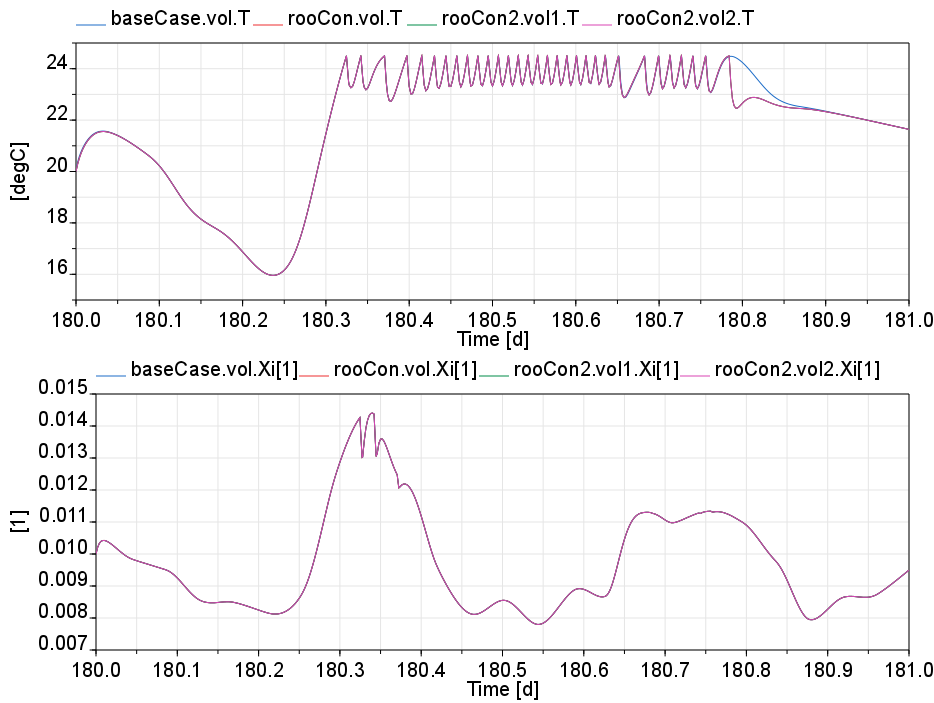
zones, are implemented correctly.When the model is simulated, one sees that the air temperatures
and the water vapor mass fraction in all four room models are the
same. Note, however, that in Dymola 2017, the base case
basCas reaches in the last cooling cylce of the day
not quite the set point, and hence switches the cooling on time
less than the other models. We attribute this to numerical
approximation errors that causes a slightly different temperature
trajectory. With Dymola 2017, we obtain the trajectories shown
below.
each keyword.