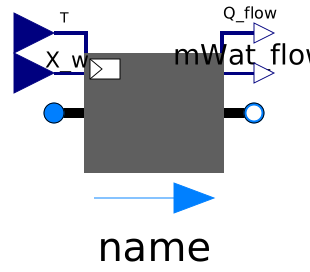
 .Buildings.Fluid.HeatExchangers.PrescribedOutlet .Buildings.Fluid.HeatExchangers.PrescribedOutlet
Model that allows specifying the temperature and mass fraction
of the fluid that leaves the model from port_b.
This model forces the outlet temperature at port_b
to be equal to the temperature of the input signal
TSet, subject to optional limits on the heating or
cooling capacity QMax_flow ≥ 0 and QMin_flow ≤
0. Similarly than for the temperature, this model also
forces the outlet water mass fraction at port_b to be
no lower than the input signal X_wSet, subject to
optional limits on the maximum water vapor mass flow rate that is
added, as described by the parameter mWatMax_flow. By
default, the model has unlimited capacity, but control of
temperature and humidity can be subject to capacity limits, or be
disabled.
The output signal Q_flow is the heat added (for
heating) or subtracted (for cooling) to the medium if the flow rate
is from port_a to port_b. If the flow is
reversed, then Q_flow=0.
The outlet conditions at port_a are not affected by
this model.
If the parameter energyDynamics is not equal to
Modelica.Fluid.Types.Dynamics.SteadyState, the
component models the dynamic response using a first order
differential equation. The time constant of the component is equal
to the parameter tau. This time constant is adjusted
based on the mass flow rate using
τeff = τ |ṁ| ⁄ ṁnom
where τeff is the effective time constant for the given mass flow rate ṁ and τ is the time constant at the nominal mass flow rate ṁnom. This type of dynamics is equal to the dynamics that a completely mixed control volume would have.
Optionally, this model can have a flow resistance. If no flow
resistance is requested, set dp_nominal=0.
For a model that uses a control signal u ∈ [0, 1] and multiplies this with the nominal heating or cooling power, use Buildings.Fluid.HeatExchangers.HeaterCooler_u
This model only adds or removes heat or water vapor for the flow
from port_a to port_b. The enthalpy of
the reverse flow is not affected by this model.
If this model is used to cool air below the dew point temperature, the water mass fraction will not change.
Note that for use_TSet = false, the enthalpy of the
leaving fluid will not be changed, even if moisture is added. The
enthalpy added (or removed) by the change in humidity is neglected.
To properly account for change in enthalpy due to humidification,
use instead Buildings.Fluid.Humidifiers.SprayAirWasher_X.
The model has been validated against the analytical solution in the examples Buildings.Fluid.HeatExchangers.Validation.PrescribedOutlet and Buildings.Fluid.HeatExchangers.Validation.PrescribedOutlet_dynamic.
massDynamics.use_dh is no longer a parameter in
the pressure drop model.