
modelLineForceWithTwoMasses
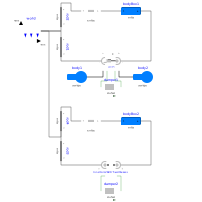
Extends from Modelica.Icons.Example (Icon for runnable examples).
Information
With this example it is demonstrated how to use the MultiBody.Joints.Assemblies.JointUPS joint to build up a force element with masses and inertias (note, MultiBody.Forces.LineForceWithMass is a default line force element with a point mass to approximate the mass properties of the component):
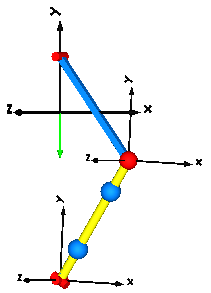
A JointUPS consists of a universal, prismatic and spherical joint aggregation that approximates a real force component, such as a hydraulic cylinder. At frame frame_ia at the universal joint and at frame frame_ib at the spherical joint, bodies can be attached describing the mass properties of the component. Between the 1-dimensional mechanical translational flanges "axis" and "bearing" a one-dimensional force law can be attached, e.g., from the Modelica.Mechanics.Translational or the HyLib package (= library of hydraulic components). In this example, just a linear damper is connected here.
Parameters
| Type | Name | Default | Description |
|---|---|---|---|
| SI.Mass | m | 1 | Mass of point masses |
Components
| Type | Name | Default | Description |
|---|---|---|---|
| SI.Force[3] | rod_f_diff | rod1.frame_b.f - rod3.frame_b.f | Difference of cut-forces in rod1 and rod3 |
| SI.Force[3] | body_f_diff | bodyBox1.frame_b.f - bodyBox2.frame_b.f | Difference of cut-forces in bodyBox1 and bodyBox2 |
| MultiBody.World | world | ||
| MultiBody.Joints.Revolute | revolute1 | ||
| MultiBody.Parts.BodyBox | bodyBox1 | ||
| MultiBody.Parts.FixedTranslation | rod1 | ||
| MultiBody.Joints.Assemblies.JointUPS | jointUPS | ||
| MultiBody.Parts.Body | body1 | ||
| MultiBody.Parts.Body | body2 | ||
| MultiBody.Parts.FixedTranslation | rod2 | ||
| Modelica.Mechanics.Translational.Components.Damper | damper1 | ||
| MultiBody.Joints.Revolute | revolute2 | ||
| MultiBody.Parts.BodyBox | bodyBox2 | ||
| MultiBody.Parts.FixedTranslation | rod3 | ||
| MultiBody.Parts.FixedTranslation | rod4 | ||
| Modelica.Mechanics.Translational.Components.Damper | damper2 | ||
| MultiBody.Forces.LineForceWithTwoMasses | lineForceWithTwoMasses |