modelForceToInputValue
Flow is obtained as closing the gap to input value
Extends from Interfaces.PartialCLD.RealInputToFlow (Partial model with real input and flow port).
Information
This information is part of the Business Simulation Library (BSL). Please support this work and ► donate.
The force to input value notation follows the one proposed by van Zijderveld [24]. It indicates some form of control as the input u provides the setpoint for a process of "closing the gap" adjustment (CloseGap) with regard to the influenced stock connected to the component's flowPort.
Implementation
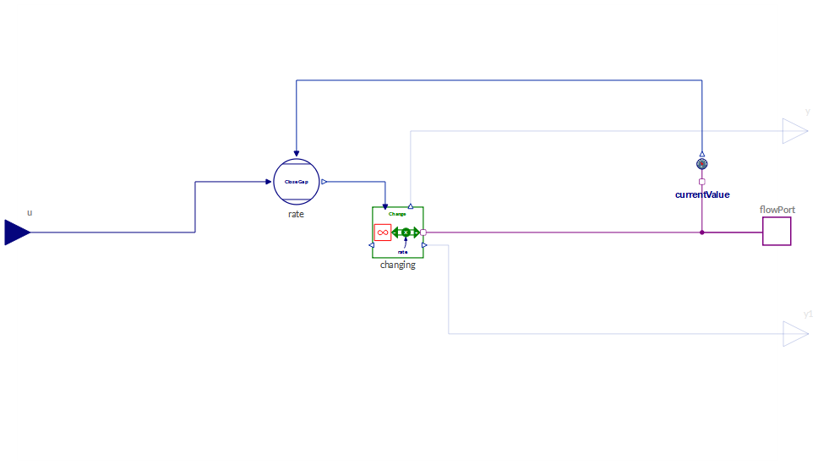 |
Notes
For more options, e.g., have control be active during limited period, use the →SimpleControl component with an option input for the setpoint (hasExogenousSetpoint = true).
See also
Parameters
| Type | Name | Default | Description |
|---|---|---|---|
| Units.Time | adjTime | modelSettings.dt | Time to close the gap |
| Structural Parameters | |||
| Boolean | hasRateOutput (from FlowPort) | false | = true, if the rate is reported via real output connectors |
Connectors
| Type | Name | Default | Description |
|---|---|---|---|
| FlowPort | flowPort (from FlowPort) | Used to represent stock and flow connections | |
| Connectors.RealInput | u (from RealInputToFlow) |
Components
| Type | Name | Default | Description |
|---|---|---|---|
| RealOutput | y (from FlowPort) | Output of current rate of flow | |
| RealOutput | y1 (from FlowPort) | Output of current rate of flow | |
| ModelSettings | modelSettings |
Revisions
- Introduced in v2.0.0.